
The Shop Stop Nobody Mentioned: How Commission Tours Work
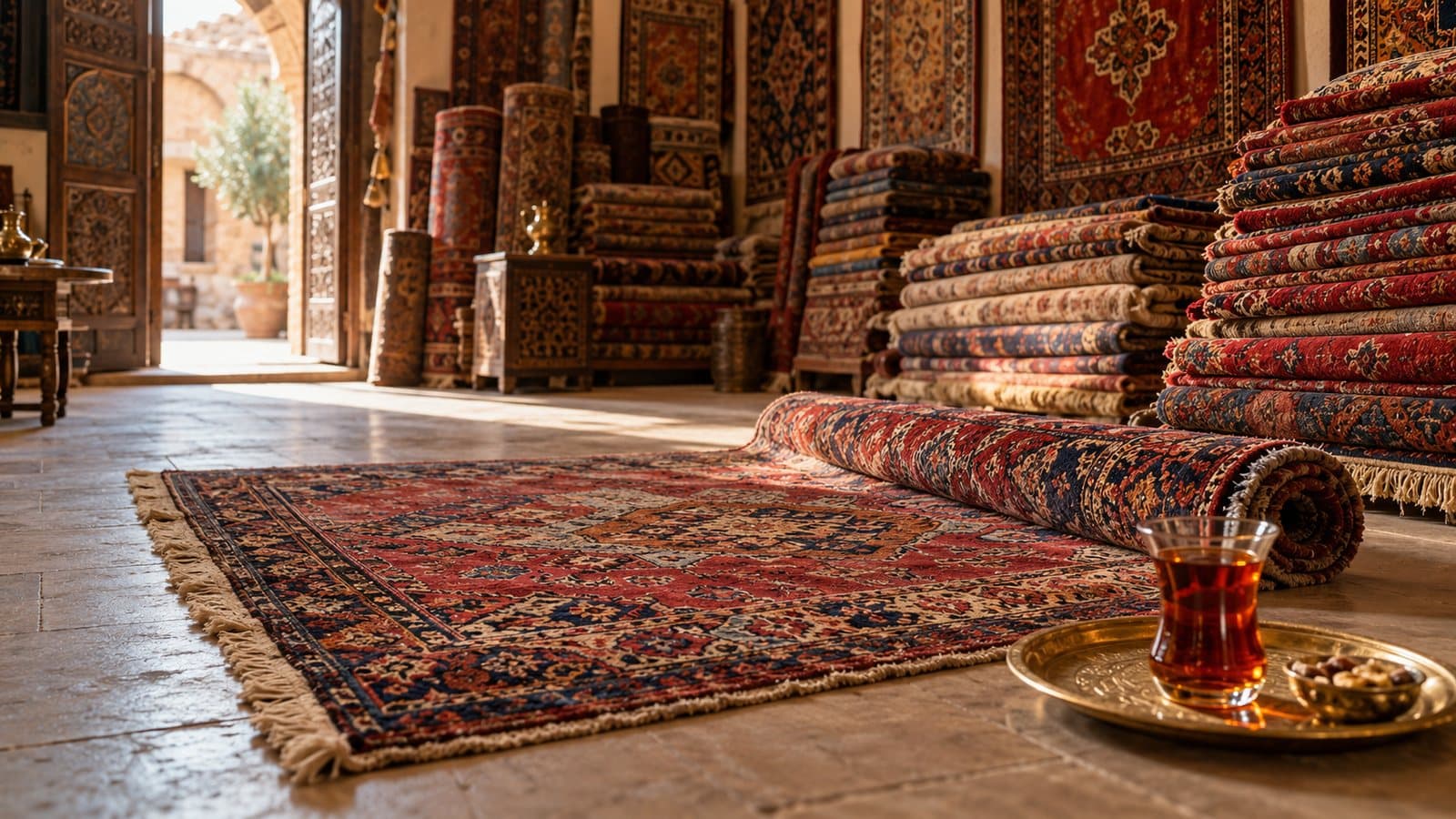
You booked a tour to see the ruins. Forty minutes later you’re sitting on a stool in a carpet showroom, holding a glass of mint tea you didn’t ask for, while a very pleasant man unrolls his seventh rug.
Nobody lied to you, exactly. Nobody told you either. That gap is the business model.
It’s the same detour around the world: jade in Thailand, alabaster in Egypt, carpets in Turkey and Morocco, a pearl “lesson” in Cabo. Here is how the stop actually works, why paying more doesn’t reliably prevent it, and the one question that does.
How the shop stop works
The shop pays whoever brings the customers. Every purchase your group makes earns a cut for the guide, and often for the driver and the local tour company too.
The percentages are hard to pin down, because nobody publishes them. Shopkeepers in Madaba, Jordan, claimed that guides near Mount Nebo take up to 20% and their agencies another 10%. A former guide in Tallinn told a Baltic news agency in 2008 the figure there also reaches 20%. Treat those as claims, not audited numbers. The direction is clear either way: the stop is a revenue line.
It also explains why the stop exists. At the bottom of the market, the commission isn’t a bonus. It’s how the tour gets paid for. In 2024, the Seoul city government sent undercover inspectors on seven low-cost package tours. They found four to eight shopping stops in a five-day trip, guides whose attitude tracked what each traveler spent, and one group held inside a store for 40 minutes until somebody bought something.
That’s the extreme. The everyday version is a 45-minute “demonstration” in the middle of a day you paid for, sold as culture.
Paying more doesn’t make it go away
The natural fix is to skip the bargain tour. It helps, but less than you’d think.
The same detour shows up on private guided days, cruise shore excursions and premium escorted tours. Paying more for a private guide buys you a better guide, not a promise about where the car stops.
Price changes how many stops you get, not whether you get one. A cheap package needs the commissions to break even. A premium tour simply includes fewer stops and gives them better names.
That naming is the part worth learning. On mainstream escorted tours, including itineraries we sell, the stop is often printed right in the day-by-day. It just doesn’t say “shop.” It says:
- “visit a carpet weaving school”
- “meet the artisans at a local cooperative”
- “learn the art of papyrus making at the Papyrus Institute”
- “see a traditional workshop” or “factory demonstration”
Some of these are worth your time. Watching a carpet being knotted by hand is genuinely interesting, and some workshops are real training programs. But nearly every one ends in a showroom, and the people walking you through it work on commission. Disclosed, yes. Clearly labeled, no.
This is different from a scam. Nobody is stealing from you, and you’re free to walk out. If you want the actual cons to watch for abroad, we cover those in In-Trip Scams: Europe, Israel and Latin America. The shop stop is a business model, and the defense is knowing how to read it.
Why smart people still buy the rug
Careful, experienced travelers come home with rugs they never meant to buy. They aren’t foolish. The showroom is built, step by step, on the oldest principles in persuasion research:
- Reciprocity. The tea, the snacks, the free demonstration. You’ve been given something, and leaving empty-handed feels rude.
- Authority. The guide you’ve trusted all day walked you in. Inside, a “master weaver” or “certified expert” explains quality you can’t judge yourself.
- Scarcity. “Only made in this village.” “This piece won’t be here tomorrow.” “The cooperative closes for the season next week.”
- Social proof. Someone in your group buys first. Now the question in the room isn’t whether to buy, but which one.
- Commitment. You’ve already given it 30 minutes. Each “just let me show you one more” makes leaving harder.
- Liking. The salesman is charming, asks about your kids, and remembers your name.
Any one of these is easy to resist at home. Stacked together, on vacation, tired, in an unfamiliar currency, they work on almost everyone. Knowing the sequence ahead of time is most of the defense.
How to keep the shop stop off your trip
Before you book
- Ask one direct question. “Are there any shopping stops or craft demonstrations, and how long is each one?” A guide or company working for you answers plainly. Anyone who calls the stop “authentic” and “not to be missed” has answered too.
- Read the day-by-day for the code words. Weaving school, cooperative, institute, factory, workshop, artisans, demonstration. Each one is probably a showroom. Then decide if you want it.
- For a private guide, put it in writing. “No shopping stops unless we ask.” If you’d actually like to shop, say what kind of places you want, and a good guide will take you to those instead.
- Know the trade-off on budget tours. If a tour is far cheaper than its competitors, the difference is being made up somewhere. Often it’s the shops.
On the day
- You don’t have to go in. Staying on the coach or waiting outside is allowed. Bring a book.
- Have a sentence ready. “It’s beautiful, but we’re not buying today.” Say it early, once, and smile. It’s easier than five softer no’s.
- Accept the tea or don’t, but don’t treat it as a debt. It’s part of the sales process, not a gift.
- Only buy what you’d buy anyway. If you love the carpet, fine. Compare it to a shop your guide didn’t choose before you commit to anything large.
Where we stand
A fair question at this point: travel agents get paid commission too. We do. Travel Connects is paid by the tour operators, cruise lines and resorts we book. We aren’t paid by any shop, restaurant or workshop you visit on the trip, so we have no reason to want you in a showroom.
Here’s what that means in practice when you book an escorted tour or river cruise with us:
- We read the day-by-day with you and point out every stop that is likely to end in a showroom, whatever it’s called.
- If a stop is optional, we tell you. If it isn’t, you know before you pay, not when the coach pulls in.
- For private guides and custom itineraries, “no shopping stops unless the client asks” goes into the request.
If you’re weighing a tour now and want a second set of eyes on the itinerary, send it to us. We’ll tell you what’s actually in it.